A MATRIX-BASED PERSPECTIVE ON PSM ELEMENT INTEGRATION
DOI:
https://doi.org/10.11113/jest.v9.230Keywords:
Process safety management, OSHA, integration, matrix analysis, risk mitigation, employee participationAbstract
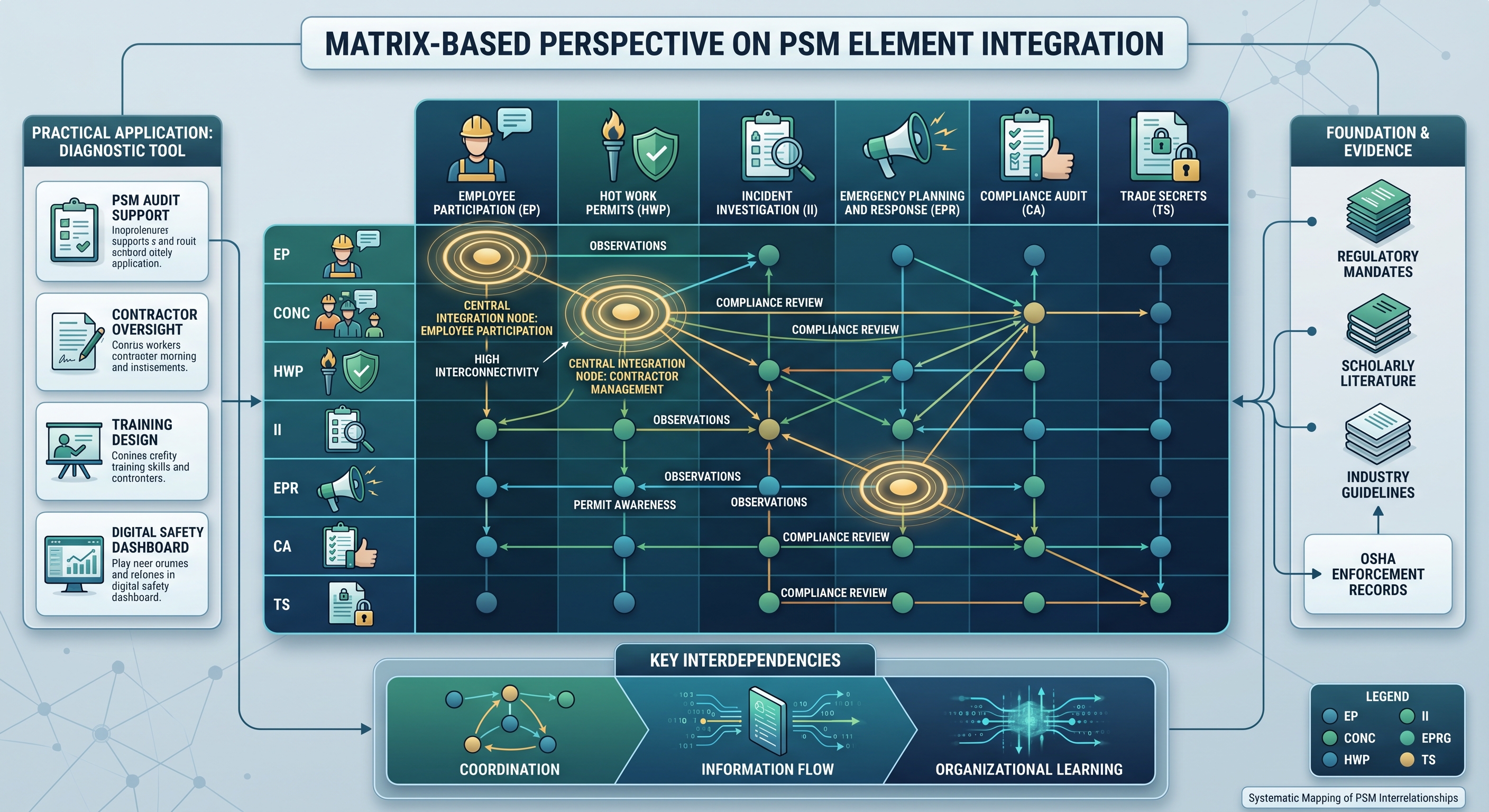
Process Safety Management (PSM) plays a crucial role in preventing or reducing the risk of catastrophic releases of hazardous chemicals, which can lead to significant health consequences, fires, explosions, and loss of life. Historical industrial disasters such as the Texas BP refinery explosion highlight the critical need for robust and integrated PSM systems to prevent both human and financial losses. Effective implementation of PSM hinges on the integration of its constituent elements. While literature emphasizes interconnections among PSM components outlined in OSHA's 29 CFR 1910.119, a systematic mapping of these interrelationships remains underexplored. This study presents a matrix-based approach to visualize and analyze the integration of seven critical PSM elements: Employee Participation (EP), Contractor Management (CONC), Hot Work Permits (HWP), Incident Investigation (II), Emergency Planning and Response (EPR), Compliance Audit (CA), and Trade Secrets (TS). The matrix was constructed using regulatory mandates, evidence from scholarly literature and industry guidelines. The results identify EP and CONC as central integration nodes, demonstrating the highest degree of interconnectivity and frequent citation in OSHA enforcement records. These findings underscore the importance of coordination, information flow, and organizational learning in sustaining effective PSM implementation. From a practical perspective, the proposed matrix offers a diagnostic tool for safety managers to support PSM audits, contractor oversight, training design, and the development of integration-focused digital safety dashboards.
References
[1] F. P. Lees, Loss prevention in the process industries : hazard identification, assessment, and control. Butterworth-Heinemann, 1996. Accessed: Sep. 08, 2017. [Online]. Available: http://www.hse.gov.uk/comah/sragtech/casepasadena89.htm
[2] S. Sivaraman, S. M. Tauseef, and N. A. Siddiqui, “Investigative and probabilistic perspective of the accidental release of styrene: a case study in Vizag, India,” Process Safety and Environmental Protection, vol. 158, pp. 55–69, Feb. 2022, doi: 10.1016/J.PSEP.2021.11.034.
[3] “US CHEMICAL SAFETY AND HAZARD INVESTIGATION BOARD INVESTIGATION REPORT VOLUME 1 EXPLOSION AND FIRE AT THE MACONDO WELL (11 Fatalities, 17 Injured, and Serious Environmental Damage) KEY ISSUES IN VOLUME 1 • MACONDO INCIDENT BACKGROUND AND GENERAL DESCRIPT…,” 2010.
[4] K. K. Pang, H. Abdul Aziz, and A. A. Patah, “SCIENCE & TECHNOLOGY Management of Change System with Integrated Risk Analysis for Temporary and Emergency Cases,” Pertanika J. Sci. & Technol, vol. 28, no. S1, pp. 159–172, 2020.
[5] Y. K. Hooi, M. Fadzil Hassan, A. M. Shariff, H. A. Aziz, N. M. Jamal, and S. Suppiah, “Analysis of Chemical Plant Process Safety Information Integration Model from Information System Perspective,” Lecture Notes in Electrical Engineering, vol. 376, pp. 289–298, 2016, doi: 10.1007/978-981-10-0557-2_29.
[6] A. Abu Bakar and H. Abdul Aziz, “Development of pre-startup safety review implementation tool for safe operation in process plant,” Process Safety Progress, vol. 43, no. S1, pp. S71–S77, May 2024, doi: 10.1002/PRS.12602;WEBSITE:WEBSITE:AICHE;ISSUE:ISSUE:DOI.
[7] H. A. Aziz, A. Mohd Shariff, and M. Muhamad, “Development of Process Safety Management System (PSMS): Mechanical Integrity (MI),” Applied Mechanics and Materials, vol. 625, pp. 486–489, 2014, doi: 10.4028/WWW.SCIENTIFIC.NET/AMM.625.486.
[8] N. D. A. Majid, A. M. Shariff, and N. A. M. Zaki, “Compliance of Hot Work Permit to Process Safety Management (PSM) Regulation,” Applied Mechanics and Materials, vol. 625, pp. 418–421, 2014, doi: 10.4028/WWW.SCIENTIFIC.NET/AMM.625.418.
[9] N. D. Abdul Majid, A. Mohd Shariff, and S. Mohamed Loqman, “Ensuring emergency planning & response meet the minimum Process Safety Management (PSM) standards requirements,” J. Loss Prev. Process Ind., vol. 40, pp. 248–258, Mar. 2016, doi: 10.1016/j.jlp.2015.12.018.
[10] N. D. Abdul Majid, A. Mohd Shariff, and R. Rusli, “Process Safety Management (PSM) for managing contractors in process plant,” J. Loss Prev. Process Ind., vol. 37, pp. 82–90, Sep. 2015, doi: 10.1016/J.JLP.2015.06.014.
[11] D. D. . Woods, Nancy. Leveson, and Erik. Hollnagel, “Resilience Engineering : Concepts and Precepts,” p. 410, 2017.
[12] S. Dekker, “Drift into Failure : From Hunting Broken Components to Understanding Complex Systems,” Drift into Failure, Dec. 2016, doi: 10.1201/9781315257396.
[13] R. Damaševičius, N. Bacanin, and S. Misra, “From Sensors to Safety: Internet of Emergency Services (IoES) for Emergency Response and Disaster Management,” Journal of Sensor and Actuator Networks 2023, Vol. 12, Page 41, vol. 12, no. 3, p. 41, May 2023, doi: 10.3390/JSAN12030041.
[14] C. Benson, I. C. Obasi, D. V. Akinwande, and C. Ile, “The impact of interventions on health, safety and environment in the process industry,” Heliyon, vol. 10, no. 1, p. e23604, Jan. 2024, doi: 10.1016/J.HELIYON.2023.E23604.
[15] “1910.119 - Process safety management of highly hazardous chemicals. | Occupational Safety and Health Administration.” Accessed: Jan. 06, 2026. [Online]. Available: https://www.osha.gov/laws-regs/regulations/standardnumber/1910/1910.119
[16] J. Zimmerman and B. Haywood, “Process Safety Management Enforcement Trends and Best Practices,” 2015.
[17] J. S. . Arendt and D. K. . Lorenzo, “Evaluating process safety in the chemical industry : a user’s guide to quantitative risk analysis,” p. 74, 2000.
[18] H. A. Aziz, A. M. Shariff, and R. Rusli, “Interrelations between process safety management elements,” Process Safety Progress, vol. 36, no. 1, pp. 74–80, Mar. 2017, doi: 10.1002/PRS.11824.
[19] “Sneak peek: OSHA reveals top 20 FY2023 violations for Part 1910 | J. J. Keller® Compliance Network.” Accessed: Jan. 06, 2026. [Online]. Available: https://jjkellercompliancenetwork.com/news/sneak-peek-osha-reveals-top-20-fy2023-violations-for-part-1910
[20] Center for Chemical Process Safety, Guidelines for Risk Based Process Safety, 1st ed. John Wiley & Sons, Inc., 2007.
[21] “PSM Citations: Trends in OSHA PSM Enforcement | Inspectioneering.” Accessed: Jan. 07, 2026. [Online]. Available: https://inspectioneering.com/journal/1996-05-01/101/psm-regulation-citations-trend
[22] F. Khan, S. Rathnayaka, and S. Ahmed, “Methods and models in process safety and risk management: Past, present and future,” Process Safety and Environmental Protection, vol. 9, no. 5, pp. 116–147, 2015, doi: 10.1016/j.psep.2015.07.005.
[23] N. D. A. Majid, A. M. Shariff, R. Rusli, and K. I. Azman, “Trade Secret Model Based on OSHA Process Safety Management Requirement,” Procedia Eng., vol. 148, pp. 1089–1095, Jan. 2016, doi: 10.1016/J.PROENG.2016.06.598.
[24] B. Strauch, “Can we examine safety culture in accident investigations, or should we?,” Saf. Sci., vol. 77, pp. 102–111, Aug. 2015, doi: 10.1016/J.SSCI.2015.03.020.
[25] S. Nenonen, “Fatal workplace accidents in outsourced operations in the manufacturing industry,” Saf. Sci., vol. 49, no. 10, pp. 1394–1403, Dec. 2011, doi: 10.1016/J.SSCI.2011.06.004.
[26] “Guidelines for Risk Based Process Safety,” Guidelines for Risk Based Process Safety, Aug. 2010, doi: 10.1002/9780470925119.
[27] K. Hungerbu and € Hler, “Risk-based Process Safety Management”, doi: 10.1002/14356007.
[28] W. L. Frank, “Process safety culture in the CCPS risk based process safety model,” Process Safety Progress, vol. 26, no. 3, pp. 203–208, 2007, doi: 10.1002/prs.10201.
[29] “CSB Emphasizes Existing Resources Available on Hot Work Safety - General News - News | CSB.” Accessed: Jan. 09, 2026. [Online]. Available: https://www.csb.gov/csb-emphasizes-existing-resources-available-on-hot-work-safety/?utm_source=chatgpt.com
[30] “Hot Work Investigations and Deployments | CSB.” Accessed: Jan. 09, 2026. [Online]. Available: https://www.csb.gov/recommendations/hot-work-investigations/?utm_source=chatgpt.com
[31] Center for Chemical Process Safety, Guidelines for Auditing Process Safety Management Systems, 2nd ed. John Wiley & Sons, Inc., 2011.
[32] “Performance Magazine KPIs used in the UK Offshore Oil and Gas Industry - Performance Magazine.” Accessed: Jan. 07, 2026. [Online]. Available: https://www.performancemagazine.org/kpis-used-in-the-uk-offshore-oil-and-gas-industry/
[33] T. Standards Program, “NOT MEASUREMENT SENSITIVE DOE HANDBOOK PROCESS SAFETY MANAGEMENT FOR HIGHLY HAZARDOUS CHEMICALS,” 2004.
[34] “Lessons Learned from 30 years of Process Safety Management | Interdisciplinary Professional Programs.” Accessed: Jan. 07, 2026. [Online]. Available: https://interpro.wisc.edu/lessons-learned-from-30-years-of-process-safety-management/
[35] “Guidelines for Technical Planning for On-Site Emergencies,” Guidelines for Technical Planning for On-Site Emergencies, pp. 1–361, Jan. 2010, doi: 10.1002/9780470938034.
[36] “CSB Emphasizes Existing Resources Available on Hot Work Safety - General News - News | CSB.” Accessed: Jan. 14, 2026. [Online]. Available: https://www.csb.gov/csb-emphasizes-existing-resources-available-on-hot-work-safety/?utm_source=chatgpt.com
[37] Occupational Safety & Health Administration, Emergency Action Plans. 2000. [Online]. Available: https://www.osha.gov/pls/oshaweb/owadisp.show_document?p_id=9726&p_table=standards